



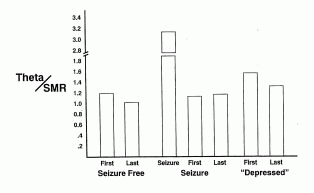
Figure 3. Two-minute baseline recording of the average that/SMR ratio at the beginning and end of neurotherapy sessions with a client with pseudoseizure disorder. Measures took place during client-reported seizure-free, seizure, and depressed periods. The theta/SMR ratios during an in situ seizure are presented with the data collected from the seizure period.
“depression” (t = 2.87, df = 12, p < .02). The theta/SMR ratio during a seizure was significantly different from all the other averages (p < .01, two tailed in all cases). The seizures remitted during the third week of treatment, when the theta/SMR ratio stabilized at an average of 1.06 (SD = 0.12).
Discussion
Lubar and Bahler (1976) have reported that if high amplitude slow-wave activity occurs in conjunction with SMR activity, either a transient increase in seizure rate or a lack of seizure decrease occurs with epileptic patients. This reported finding is consistent with the findings reported here indicating a relationship between the theta/SMR ratio and seizure activity. Further, the observation that seizure activity of the patient described in case one was also associated with her electrodermal activity suggests that pseudoseizure disorder may be essentially an arousal disorder. The beneficial effects of SMR training may be that the SMR inhibits or suppresses excitation in the sensorimotor area.
In summary, although psychological mechanisms appear prevalent in pseudoseizure disorder, and some patients experience reductions or elimination of seizures during the first year after diagnosis, the cases reported here had all been diagnosed a minimum of 7 years prior to theta/SMR treatment. It is apparent, therefore, that seizure activity is directly related to the theta/SMR ratio, and that reductions in the theta/SMR ratio brought about by neurofeedback are associated with reductions in seizure behavior. Due to the rare nature of this disorder, however, control groups are difficult to obtain, which in turn limits the extent of these findings. Nonetheless, the use of theta/SMR
training to reduce seizure behavior concurrently with psychotherapy to address the contributing psychological issues seems prudent to facilitate enhanced social functioning of patients with pseudoseizure disorder.
Portions of the data from the first case report were presented at the meetings of the Society for the Study of Neuronal Regulation, Las Vegas, Nevada, 1994.
References
Ayers ME (1993): A controlled study of EEG neurofeedback training and clinical psychotherapy for right hemisphere closed head injury [abstract]. In: Proceedings of the Association for Applied Psychophysiology and Biofeedback. pp 19-20.
Bowman ES (1993): Etiology and clinical course of pseudoseizures: Relationship to trauma, depression, and dissociation. Psychosomatics 34:333-342.